
Omkar Khadamkar
AI-generated UI looks finished long before it is correct. I make design systems machine-readable — and I measure whether it worked. Most of the platform is built by people who don’t report to me.
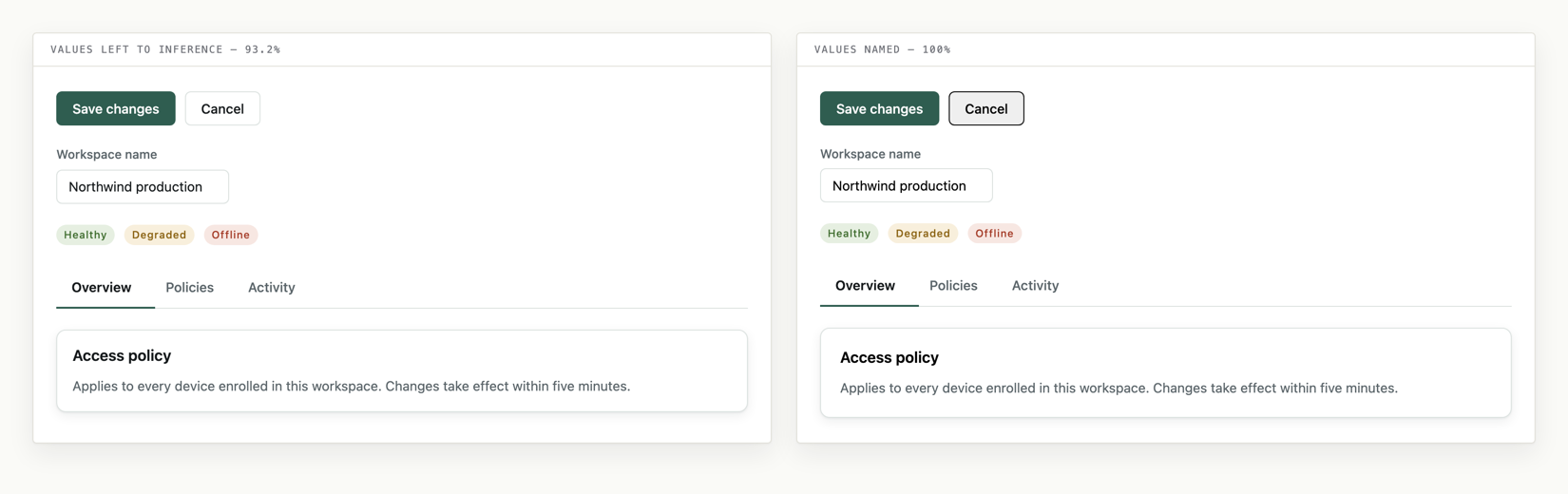
A component library got generated UI a quarter of the way onto our system. Documentation a machine couldn’t misread took it to 90%. Read the case study →
I argued the layout had to be replaced — then had to beat the concept my own team preferred. 43 participants picked mine. Now a filed US patent. Read the case study →
I published a claim about why AI-generated UI drifts, then built a rig to test it. The claim failed. I published that too. Read the case study →
If naming every value is what matters, can one perfectly documented component teach the rest? It taught nothing — and made every remaining error deterministic. Read the case study →
Twelve rows selected, twelve different values — what should the field show? A working component you can use in the page, not a screenshot of one. 53 tests. Read the case study →
I have never had a direct report. Since 2013, getting design quality out of people under no obligation to give it to me — and what you have to build when you cannot simply decide. Read it →
AI-native design systems
Component guidelines a model cannot misread, specs carrying exact values, and stylesheets bound to the production token file.
The system →Drift verification
Regeneration diffs, audit rubrics, checksum tripwires. Proving a system still holds after AI touches it, rather than assuming it does.
The field test →Systems at scale
Governance, adoption, contribution models, coaching. The unglamorous half: getting the thing used by people who did not build it.
How that works without a reporting line →Design engineering
Component-to-code mappings, instrumentation specs, agent tooling. Built for engineering, for design, and once for a revenue team — only one of those is my own function.
A working component, 53 tests →| Years | Organisation | Role & focus |
|---|---|---|
| 2022 – 2026 | Skyhigh Security | Staff UX Designer. Enterprise design system across SSE, ZTNA/Private Access, Cloud Firewall, CASB and reporting. AI-native documentation, drift verification, and agent tooling built for teams outside design. |
| 2020 – 2022 | VMware | Member of Technical Staff (UX Designer). NSX networking and security. First-named inventor on VMware’s filed patent application for network status visualisation (US 2025/0036264). |
| 2020 | FactSet | Sr. UX Specialist. Visual design guidelines across the product portfolio. |
| 2019 – 2020 | Valuelabs | Sr. UX Designer. Enterprise workflows and component libraries. Design for Social Innovation award, UX Design India. |
| 2013 – 2016 | Future Group | Assistant Design Manager. Guideline systems for manufacturers and buyers. |
| 2023 – 2024 | UT Austin, McCombs School of Business | Post Graduate Program, AI & Machine Learning |
| 2019 | IIT Roorkee | Doctoral coursework — Inclusive Design. Completed the first semester, then left for a senior design role. |
| 2016 – 2018 | National Institute of Design | Master of Design |
| 2009 – 2013 | National Institute of Fashion Technology | Bachelor of Design |
Currently open to conversations
Design systems, AI-native documentation, and the seam where generated UI meets a real system. Remote roles and consulting both.